We are currently witnessing one of the most frenetic technology gold rushes in modern history. Every week, thousands of founders, engineers, and enterprise leaders deploy artificial intelligence wrappers, autonomous agents, and decentralized blockchain networks with breathtaking speed. The barrier to technical prototyping has effectively dissolved; what once took an engineering department six months can now be scripted over a weekend using foundation model APIs.
Yet, beneath this surface-level abundance lies a brutal statistical reality: roughly ninety percent of AI and emerging tech ventures collapse within their first three years.
This is not a failure of engineering. It is a failure of architecture.
When I consult with technology entrepreneurs and investors, I see the same recurring pathology. Founders become intoxicated by the raw capability of their tools, rushing to market without pausing to construct the foundational load-bearing walls of a viable business model. They assume that if the technology is advanced enough, the market economics will naturally follow.
In enterprise strategy, however, it is not about what the technology can execute, it is how the business model captures and sustains value. To survive the current gold rush, entrepreneurs must move beyond the intoxicating allure of raw code and subject their ideas to a rigorous diagnostic framework before spending a single dollar of capital.
That diagnostic framework is the Three-Value Test.
The Illusion of Technical Velocity in the AI Gold Rush

To understand why modern ventures fail with such alarming regularity, we must examine the mismatch between creation speed and validation depth. Cheap prototyping has created a dangerous illusion: the belief that shipping an application equals establishing a business.
Industry data reveals that the vast majority of generative AI pilots and early-stage startups fail to deliver measurable return on investment. The primary culprit is not model hallucination, API latency, or infrastructure cost. It is a complete absence of validated market need, accounting for over forty percent of all startup post-mortems, compounded by unsustainable unit economics.
“Speed without structural integrity is simply a faster way to burn capital.”
When founders ask me to review their pitches, I frequently encounter brilliant technical architectures coupled with commercial vacuums. They have built an extraordinary engine, but they have forgotten to verify whether anyone is willing to pay for the journey. Investors are acutely aware of this vulnerability. When venture capitalists pass on an emerging tech pitch, they are rarely rejecting the intelligence of the algorithm; they are rejecting the absence of a defensible economic engine.
To bridge this gap, founders need a systematic way to join the dots between technical capability and commercial sustainability. They need a litmus test that strips away the hype and interrogates the core architecture of the venture.
The Three-Value Test: A Diagnostic Framework
In my work designing enterprise strategies and business models, I rely on a structured tripartite evaluation. It is not enough for an idea to be novel; it must prove its resilience across three distinct dimensions of value.
If an idea falters at any of these three levels, the venture will either bleed cash or stall in the market.
1. Functional Value: The Baseline of Capability
The first pillar of the test is Functional Value. This addresses the immediate operational question: What specific task does this technology perform better, faster, or cheaper than existing alternatives?
This is where ninety percent of tech entrepreneurs concentrate their entire focus. They demonstrate that their AI agent can summarize documents in seconds, or that their blockchain protocol can verify supply chain provenance with cryptographic certainty.
Functional value is essential, but it is merely a threshold requirement. In a market saturated with open-source models and interchangeable APIs, functional superiority has a half-life of weeks. If your competitive advantage relies entirely on performing a digital task faster, a larger incumbent will inevitably absorb or replicate your feature in their next software update.
2. Economic Value: The Calculus of Sustainability
The second pillar is Economic Value. This shifts the inquiry from capability to commerce: What is the financial viability of this venture; does it save, protect, or generate for the buyer, and what are the unit economics of delivery?
This is where the gold rush encounters its reckoning. Many AI and blockchain applications generate impressive engagement metrics while quietly destroying unit economics. When customer acquisition and operational expenses outstrip the actual willingness-to-pay of the customer, the business model is mathematically inverted. You are subsidizing your users' efficiency out of your own capital reserves.
Evaluating economic value requires rigorous mapping, or joining the dots of how the idea will actually work; before you are in any position to assess its economic value.
3. Strategic Value: The Architecture of Sustainability
The third and most frequently neglected pillar is Strategic Value. This asks the definitive question for investors and long-term operators: What long-term competitive advantage, proprietary asset, or sustainable moat does this venture create over time?
Strategic value is what separates a transient software wrapper from an enduring enterprise. It is forged through the fundamental business elements of customers, operational activities, partnerships & resources and financial viability.
Without strategic value, your venture is perpetually vulnerable to commoditization. When the underlying foundation models improve or platform providers alter their terms, unstrategic ventures find their entire business model disintermediated overnight.
Why Most Ventures Fail the Test

When I analyze why venture after venture stumbles during fundraising or early commercialization, the pattern is unmistakable: they nail functional value, ignore economic reality, and completely omit strategic sustainability.
A founder arrives with a sophisticated machine learning model designed to forecast retail inventory. The functional value is undeniable, it forecasts demand with high precision. But when investors ask about economic value and distribution, the cracks appear. The setup costs require lengthy enterprise sales cycles, the API consumption costs exceed the subscription fee, and there is no proprietary data asset preventing a major cloud provider from offering the exact same capability as a native feature next quarter.
It is not enough to build something clever. You must architect something robust and sustainable.
This requires shifting your mindset from that of a software hobbyist to that of an enterprise architect. You must inspect every assumption before writing code, ensuring that your technical innovation is securely anchored to commercial and strategic reality. You can explore more of my perspectives on aligning technical execution with enterprise architecture in my piece on transforming cool tech into sustainable value.
Joining the Dots: From Idea to Viable Business Model
My core philosophy centres on "joining the dots." Complex emerging technologies, whether applied machine learning, generative AI, or distributed ledgers, often appear opaque and intimidating to business leaders and investors alike.
My role as a strategist is to demystify that complexity, translating abstract technical potential into clear, actionable business frameworks. When you apply the Three-Value Test to your concept, you transform a vague hypothesis into a structured blueprint. You can immediately identify whether your venture possesses the functional edge, the economic margin, and the strategic moat required to secure investment and capture market share.
[Technical Innovation] ---> [Functional Value] ---> [Economic Margin] ---> [Strategic Moat]
By methodically connecting these dots before deployment, you protect your most valuable resources: your time, your capital, and your intellectual energy. You stop guessing what the market might want and start designing what the market must have.
Build with Purpose, Test Before You Deploy
The AI and blockchain gold rush will continue to reward those who approach innovation with intellectual rigour and structural discipline. The founders who survive and thrive will not be those who shipped the fastest, but those who validated their value propositions the deepest.
Do not wait for an investor rejection to discover the structural flaws in your business model. Stop, examine your foundations, and run the Three-Value Test today.
If you are ready to move beyond the hype and map a sustainable, investor-ready business model from your technical idea, let's connect and explore my consulting services. Rigour, clarity, and purpose are the ultimate competitive advantages in a crowded market.

About Marcus Xavier
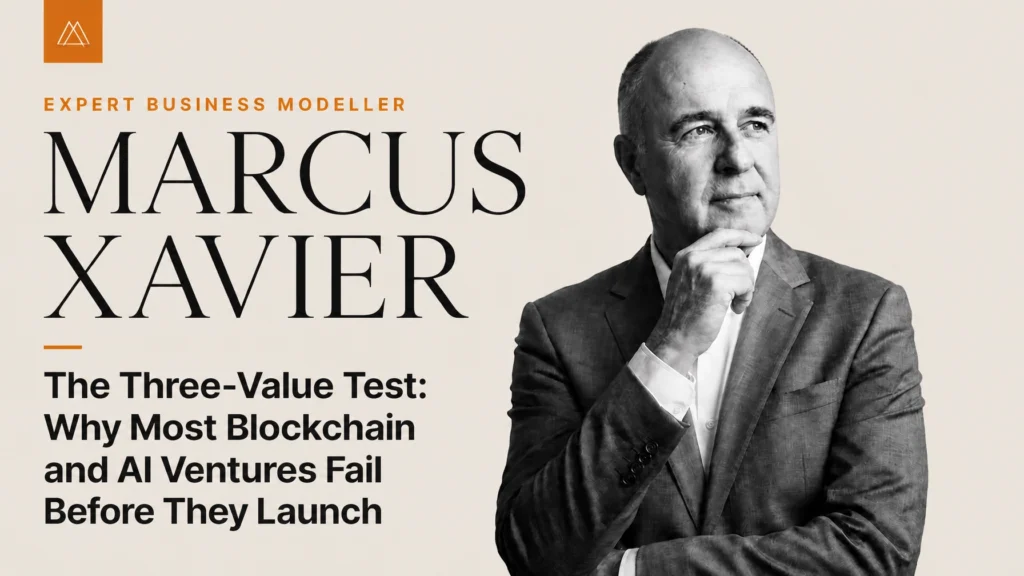
Marcus Xavier is an expert in creating business models from technical ideas, helping entrepreneurs "join the dots" between innovation and sustainable value. He specializes in disruptive business modelling, AI and blockchain strategy, and enterprise architecture.
Ready to subject your technical idea to the Three-Value Test? Connect with Marcus here.